|
Prosticks Articles
Hong Kong Economic Journal --- 20 Nov, 2000
Using Bollinger Bands to Find Support and Resistance
The Bollinger Bands is a very popular technical
analysis tool in United States invented by John Bollinger.
Recently, it also starts to gain appeal among
practitioners in Hong Kong.
The Bollinger Bands consists of an upper band and a
lower band. These bands are derived using statistical
theory based on historical closing prices. The exact
formula for the bands can be found in the website
www.bollingerbands.com
The are two ways to use the Bollinger Bands. In one
approach, it is considered that the two bands mark the
overbought and oversold zone. Thus, when price rises and
touches the upper band, the market is overbought. A
correction is anticipated. Similarly, when price falls
deep enough to touch the lower band, it is in an oversold
condition. Of course, this is an over-simplified
situation. One has to look at other indicators such as RSI
in order to avoid technical traps.
In another approach, Bollinger Bands can be used to
indicate the beginning of an uptrend or downtrend. In a
trending market, the bandwidth (the distance between the
upper and lower band) is very wide. On the other hand,
when the bandwidth is very narrow, it signifies an extreme
consolidation market. If price closes above or below a
band, it indicates either an upside or downside breakout.
A trend is expected to follow.
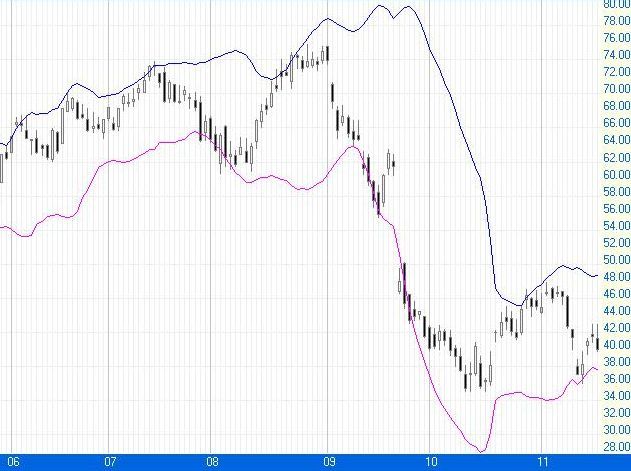
Figure 1 shows the Candlesticks chart of Intel together
with the Bollinger Band.
Modal Platform can be incorporated into Bollinger Band
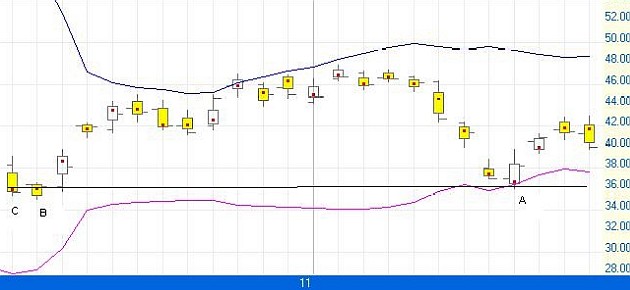
analysis in order to get a more accurate judgment. Figure
2 shows the Prosticks chart of Intel. As can be seen, when
price fell to the lower band at A, a rebound
occurred. Coincidentally, at A, the band is at the
same level as a previous Modal Platform formed by Modal
Points of B and C. Thus, when price fell to A,
there are two kinds of support: the Bollinger Band, and
the Modal Platform, occurring at exactly the same price.
The rebound should have been anticipated. As can be seen,
from the low of $36 to the high of $42.875 within three
days, the profits are quite nice.
|