|
Prosticks Articles
Hong Kong Economic Journal --- 6 Nov, 2000
Significance of Opening Price
The reason why we study charts is because charts
reflect all the economic and political factors. Some
traders claim that they do not need to listen to news or
commentary. The charts already tell them what is happening
in the economy. This saying may be a bit extreme. However,
chart movements, especially volume distributions, do
reflect the market demand/supply equation and this
equation is determined by fundamental factors.
Consider our concept of Active Range. The Active Range
comprises 68% of volume traded during the day. The market
has consolidated around this range throughout the trading
session. It is thus the range which market participants in
aggregate have agreed to trade on given all the available
economic and political conditions. In other words, it is
the fair value of the market.
As such, in the following day, if the market
fundamentals do not change significantly, price should
continue to trade inside the previous day's Active Range.
However, if the Active Range of the following day
increases or decreases, then we should know that the
fundamentals forces have shifted either positively or
negatively, even though we had not listened to the news.
Sometimes we can detect this shift in market
fundamentals right from the opening price. Consider a bear
market. Everyone expects the market to fall. However,
unexpectly, it opens bullishly above the previous day's
Active Range. Other things being equal, something may have
happened in the economy which cause buyers to enter the
market desperately and bid above the Active Range, right
from the market open. The bears have to be cautious.
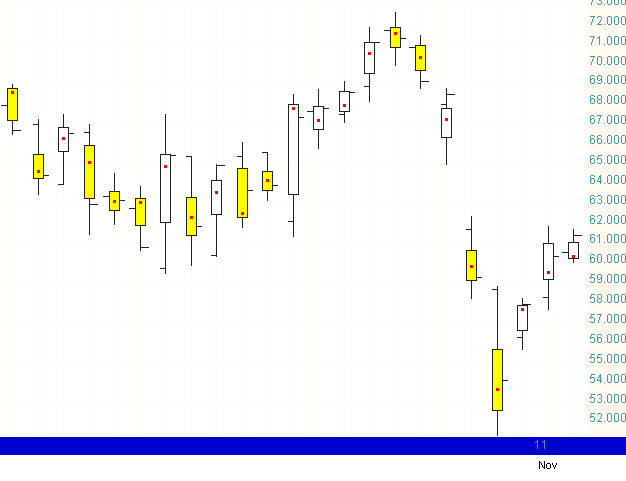
The figure shows the Prosticks chart of Amgen. Amgen is
one of the largest biotechnology company in the United
States. It is one of the constituent of Nasdaq-100 Index.
Besides, it is also listed in Hong Kong Stock Exchange
under the stock code 4332.
As can be seen from the figure, bar A is a very
bearish bar. It is a long falling bar. Both Active Range
and Modal Point are concentrated in the lower part of the
bar range, indicating that most trades were transacted at
low prices. The market also closed inside the Active
Range, signifying bearishness. Under these gloomy market
conditions, naturally, the market should open inside the
Active Range the next day at B, if not below.
However, unexpectedly, the market opened above the
Active Range the following day. This signified that some
desperate buying forces had entered the market. Some
changes had taken place in the underlying fundamental
factors which most traders had not been aware of. As can
be seen, after opening above A's Active Range, the
market sank to retest A's Active Range momentarily.
However, once price touched the Active Range, buying
orders emerged again and propelled price upwards.
Eventually the market closed near day high. The Modal
Point is near day high also. For the following two days,
the market continued to rise.
In short, one should examine the relationship and
relative placement among open price, close price, and the
Active Range. Remember, the Active Range is the market
value. If price "unexpectedly" opens or closes
outside this value, it means some fundamentals may have
changed, at least in the short term.
|